
 Image 1 of 1
Satellite connectivity provides internet or private network access by transmitting data between a customer terminal and satellites in orbit, rather than relying on terrestrial infrastructure such as fibre, copper or mobile masts. It can be delivered via LEO, MEO or GEO systems, selected based on latency requirements, throughput and deployment constraints.
For sites where terrestrial options are unavailable, impractical or too slow to deploy, satellite offers infrastructure independence, rapid activation and a diverse-path backup to existing connectivity — with no civil works and no dependency on local carrier build.
-
There are three common types of satellite connectivity, each suited to different use cases—but all can deliver significant value depending on the requirement.
Low Earth Orbit: LEO services use constellations in low earth orbit (approximately 160–2,000 km / 100–1,240 miles), which keeps latency low—often comparable to terrestrial broadband depending on location and routing. LEO is typically used where fixed or mobile options are unavailable, impractical, or uneconomic, and is increasingly considered a viable primary broadband option.
Medium Earth Orbit: MEO constellations orbit at approximately 2,000–35,500 km, providing wider coverage per satellite than LEO but with higher latency. MEO is widely used for GNSS/GPS and can also support high-throughput connectivity for remote sites where ultra-low latency is not essential.
Geo Stationary Orbit: GEO satellites operate from around 35,786 km / 22,236 miles, appearing fixed in the sky and providing very broad coverage. GEO is commonly used for wide-area communications, resilient backup connectivity, and lower-bandwidth applications such as IoT—though it typically has materially higher latency (often around 600 ms) than LEO.
Opious primarily deploys LEO satellite solutions from providers including Starlink, OneWeb and Amazon’s emerging LEO service. -
Satellite is typically appropriate where:
A site has no viable fibre or fixed broadband
Mobile signal is inconsistent or absent
Deployment timelines cannot accommodate civil works
Geographic isolation limits terrestrial build options
Business continuity requires technology resiliency
It is frequently deployed across rural estates, temporary projects, remote infrastructure sites and contingency planning environments, as well as primary connectivity for smaller sites with known data requirements.
-
Key considerations include:
LEO, MEO or GEO? Based on latency tolerance and application profile.
Primary or backup connectivity? Determines bandwidth allocation and routing logic.
Throughput expectations? Influences terminal specification and service tier.
Anticipated data usage? Like mobile data, satellite can be costly with data consumption.
Integration into LAN or MultiWAN? Defines resilience architecture.
Physical environment? Line-of-sight, mounting position and environmental exposure.
These decisions guide terminal selection, network integration and performance modelling.
-
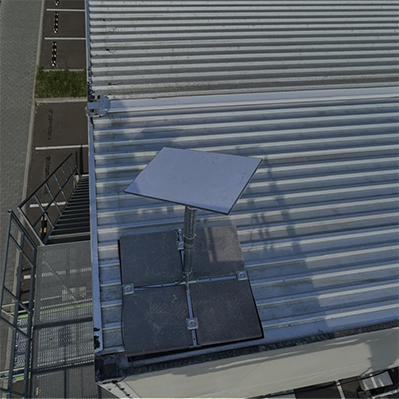
We deploy enterprise-grade satellite antennas that require a location with an unobstructed 100° view of the sky in order to maintain consistent connectivity, ensuring that all equipment is deployed in line with manufacturer best practices and secured using specialised antenna mounts.
Opious Satellite solutions are deployed as a fully managed service, offering a static IP address, 24/7 network monitoring and data reporting functionality. -
Satellite connectivity offers infrastructure independence and rapid activation.
Compared to traditional fixed line services:Deployment is faster taking a matter of days as opposed to months.
Latency is higher than fibre but significantly improved in LEO environments compared to legacy satellite.
No civil works or Excess Construction Charges but likely to require landlord approval for installation.
For high-density urban environments with available fibre access, fixed circuits may offer lower latency and guaranteed throughput. For remote or isolated sites, satellite provides practical and reliable access where terrestrial options are not viable.
-
Unobstructed view of the sky is essential. Obstructions can degrade performance.
Weather conditions can influence signal stability, particularly in extreme conditions.
Latency, while reduced in LEO, is not on par with fibre. Application suitability should be assessed.
Power stability matters. Satellite terminals require consistent power supply.
Our approach is to assess environmental and operational variables early to ensure satellite performance aligns with business expectations.
-
Warehouses and large industrial sites — extensive indoor footprints where handheld devices, mobile workflows and staff communication depend on consistent 4G/5G coverage across the full floor, including areas far from the building perimeter.
Corporate offices and campuses — high device density environments where modern construction materials block external signal and user expectations for mobile performance are high.
Retail and hospitality environments — customer-facing spaces where both staff productivity and visitor experience depend on consistent mobile connectivity, including in areas with high footfall or concurrent device use.
Transport hubs and public venues — locations with heavy, variable footfall where demand spikes rapidly and network capacity needs to scale with it.