
 Image 1 of 1
Mobile Data Services are designed to provide enterprise-grade connectivity over pre-existing public cellular networks. They are used where speed of deployment, flexibility or infrastructure constraints make fixed-line connectivity unnecessary, delayed or disproportionate to site needs.
-
Built on market-leading technology with integrated 5G, our Mobile Data Services provide secure, dependable connectivity.
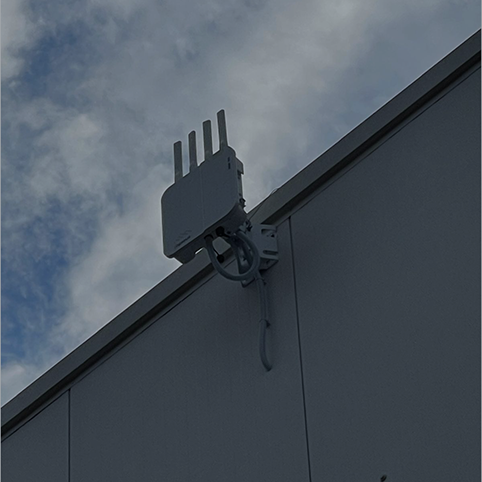
Unlike consumer mobile broadband, these deployments are engineered environments — incorporating external or high-gain antennas, traffic prioritisation, network monitoring and remote management.
They can operate as:A permanent primary connection for smaller sites
Temporary connectivity during launch or transition
Backup connectivity alongside fixed-line circuits
A component within a bonded Multi-WAN architecture
A connectivity method for remote IoT sensors
-
Mobile data is an ideal technology where:
A site must go live quickly
Fibre lead times are excessive
The location is temporary or semi-permanent
The cost and complexity of fixed circuits outweigh operational need
IoT connectivity is needed where fixed lines aren't practical
It is commonly used across distributed retail estates, kiosks, satellite offices, events and construction sites — and increasingly as a long-term primary solution for smaller footprint locations.
-
Several practical decisions influence the final architecture:
Permanent or temporary? Determines hardware lifecycle and deployment approach.
Stationary or mobile? Impacts antenna / equipment selection and ruggedisation.
Primary or backup? Defines resiliency requirements, failover logic and monitoring depth.
Internal or External Installation? Influences installation methods and data cabling considerations.
Single carrier or multi-network? Affects resilience and coverage optimisation.
Self-install or fully managed? Determines configuration control and support model.
These choices guide router specification, antenna configuration, SIM strategy and resilience design.
-
Deployments use enterprise-grade routers from vendors such as Eero, Ericsson, Teltonika & Ubiquiti, selected based on throughput requirements, environmental conditions and integration needs.
Signal optimisation is achieved through internal or external antenna systems — including directional or high-gain options where signal strength requires enhancement.
We support both physical SIM and eSIM provisioning as well as direct carrier and MultiNet SIMs:Physical SIMs are suitable for individual or static deployments.
eSIM technology enables remote provisioning, simplified multi-site rollout and carrier switching without hardware replacement.
Direct Carrier SIMs are provided from a single carrier such as Vodafone, Telefonika, Orange.
MultiNet SIMs have the ability to roam across multiple networks and countries.
4G remains highly effective for IoT sensors, retail EPOS, SaaS applications, payment terminals, and CCTV backhaul.
5G is ideal where higher bandwidth, lower latency, or greater device density is required — including high-footfall retail, live media environments, and data-intensive operational systems.
Routers may operate standalone or integrate into bonded MultiWAN architectures for enhanced resilience and bandwidth aggregation.
-
Mobile connectivity differs from fixed-line circuits in several important ways.
Speed of deployment: Mobile services can typically be installed and live within days, whereas leased lines or fibre circuits may require weeks or months depending on civil works and carrier lead times.
Infrastructure dependency: Fixed lines rely on local fibre availability and physical build. Mobile data depends on carrier network coverage and radio signal conditions.
Performance profile: Leased lines offer dedicated bandwidth and predictable throughput. Mobile networks operate over shared public spectrum, meaning performance can fluctuate depending on local network congestion.
Flexibility: Mobile connectivity can be relocated, scaled or reconfigured more easily than fixed infrastructure, making it well suited to distributed estates or evolving environments.
For smaller sites or moderate workloads, mobile can provide a practical long-term alternative to fibre. For high-throughput, latency-sensitive or heavily centralised environments, fixed circuits may remain the more appropriate primary solution. -
As with any connectivity model, there are practical realities that should be understood before deployment:
Signal strength matters. Coverage maps are indicative; on-site testing is essential, particularly in reinforced or shielded buildings.
Indoor performance may require external antennas. High-gain or directional antennas are often used to stabilise throughput and reduce variability.
Network congestion can affect peak-time performance. Public mobile networks are shared infrastructure.
Carrier policies differ. Data plans, traffic management and NAT configurations vary between operators.
5G availability does not always equal 5G performance. Device capability, spectrum band and local cell load all influence real-world speeds.
Our role is to assess these variables early, design around them, and ensure expectations are aligned with operational requirements.
-
New Site Launches
Connectivity required before permanent circuits are available.
Retail & Distributed Estates
Permanent primary connectivity for smaller footprint sites.
Events & Temporary Venues
Short-term operations requiring rapid activation.
Business Continuity Planning
Backup connectivity during primary circuit outages.